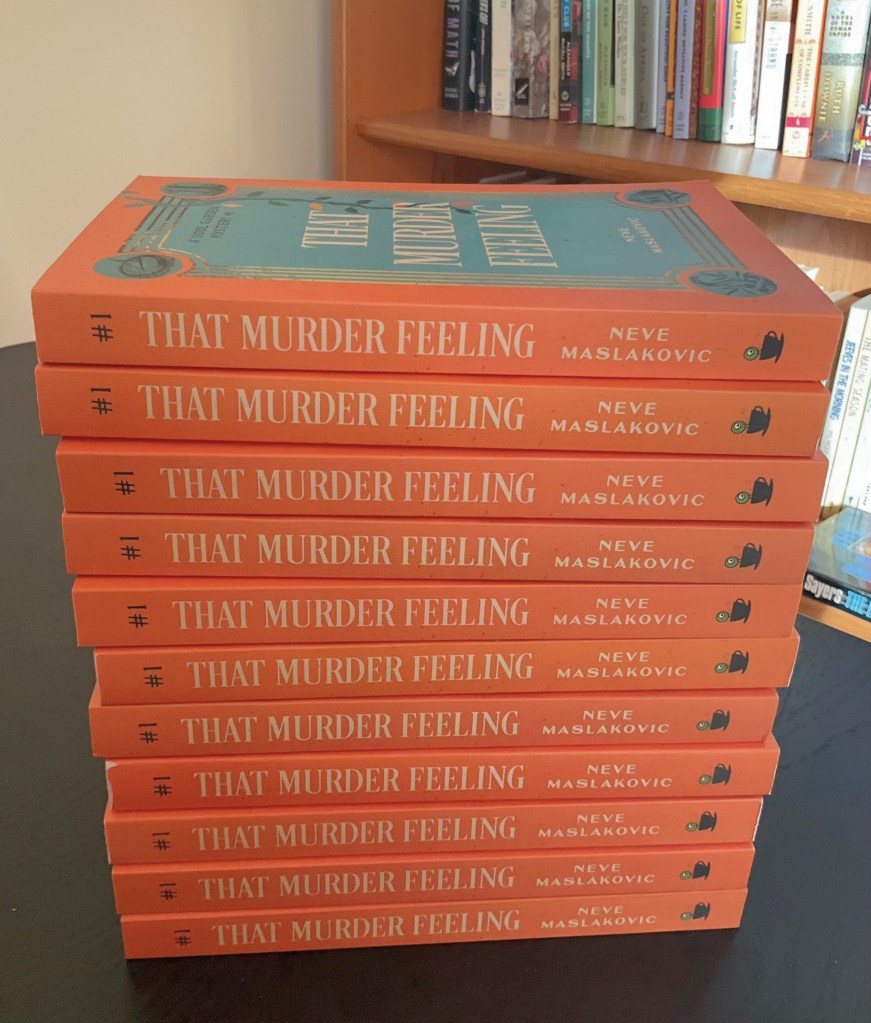
My box of author copies of That Murder Feeling kept being delayed in shipping but finally arrived earlier this month. I love how that orange looks. It’s not quite so bright as in appears in the photo, more of a weathered, pastel hue.
I’ve mailed off copies of the book to the beta readers who kindly provided feedback on the early drafts — if you are on that list and didn’t get your paperback or ebook copy, let me know!
Huge appreciation to the beta readers and a big shoutout also to the book’s developmental editor, Kristen Weber, and its copy-editor, Shannon Page. I’m grateful for their sharp eye and care. Couldn’t have done it without them.
Signed Books
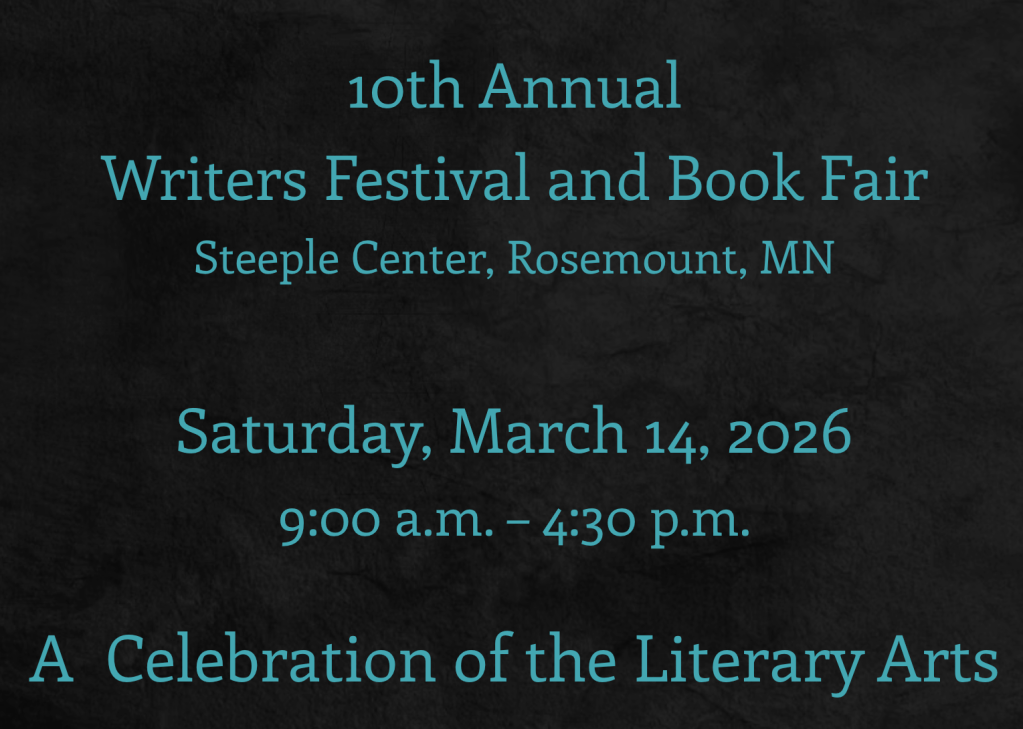
If you’re in the Twin Cities area, I’ll be signing/selling books at the Rosemount Writers Festival, our local book event here south of the Cities. The festival takes place on Saturday, March 14, 2026 from 9:00 a.m. – 4:30 p.m.
Hope to see you there!
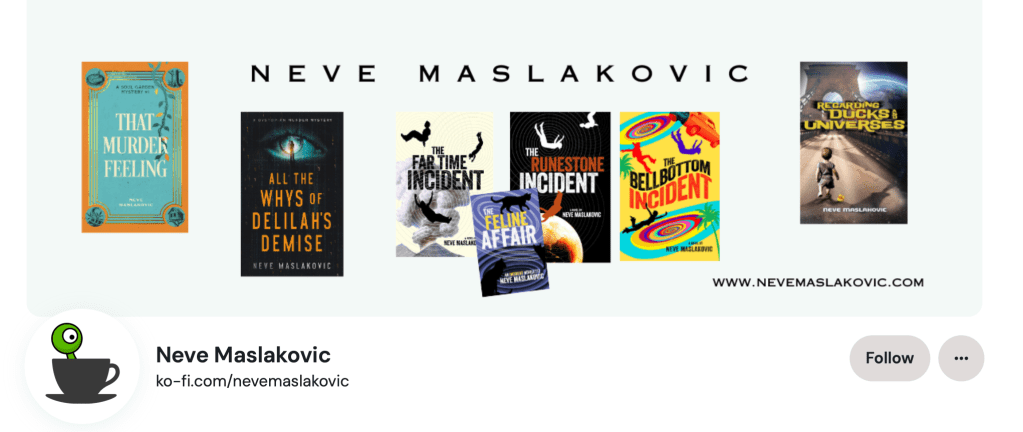
Order signed copies online! If you would like to order a signed paperback to be mailed to you, I’ve set up a Ko-fi page (pronounced “coffee,” as in “buy your favorite creator a cup of coffee.”) I’ll list books there as I happen to have them in stock, which is to say stacked on a bookshelf in my office. The books on the shelf tend to ebb and flow depending on what events/giveaways are going on. At the moment there are three listed on Ko-fi: That Murder Feeling (Book 1 of the new series), All the Whys of Delilah’s Demise (a standalone novel) and Regarding Ducks and Universes(also a standalone novel).
And don’t forget to let me know if you’d like your copy personalized!
What I’m Reading
I’ve been on a mystery reading stretch the last month or two. Here are a couple of books that I enjoyed:
Seven Reasons to Murder Your Dinner Guestsby KJ Whittle. A modern day retelling of Agatha Christie’s And Then There Were None. A page-turner. London as the setting, sharply drawn characters, and an unsettling ending.
My genre-bending whodunit, That Murder Feeling, is out today in ebook and paperback! I’m thrilled to finally have the book out in the world. As you can see in the photo above, Grif the goldendoodle thoroughly checked out the draft copy and approved it. (For scale, the dog is 50-ish pounds and the book is 5.5 by 8.5 inches and 309 pages long.)
I had a lot of fun writing this. Coming up with the various garden elements and creatures to represent each of the (many, so so many) feelings and emotions that made it into the story. Weaving them onto the pages alongside the mystery arc. Wondering if any of it made sense in the end and hoping it did. You can read Chapter One here.
The ebook is available on all platforms. The paperback just went up on Amazon and will appear on other retailers in the next few weeks. I’m working on a way to make signed copies available — more details on that in the next newsletter.
If you’d like to ask your local library to carry the title, the ebook is listed in the OverDrive catalogue and also cloudLibrary. Libraries can order print copiesfromIngramSpark. (ISBNs: ebook 978-1-7366979-2-4 / paperback 978-1-7366979-3-1)
Bonus content for subscribers to this newsletter! Click here for access to a hidden page on my website, where you’ll find a catalogue of all the named feelings and emotions in That Murder Feeling, plus a couple of other things. I recommend waiting until after you’ve finished reading, as there are spoilers.
Hope you have as much fun reading this one as I had writing it.
Let’s jump right to it, the cover for my new mystery series starter, That Murder Feeling!
This is my sixth book and the first one that belongs more on a mystery shelf than a sci-fi one.
When I started writing it, I knew it would land somewhere between a classic whodunit and something a bit stranger—imagine if Inspector Gamache wandered into a Stuart Turton novel—and that it’d likely be tricky to nail the right tone for cover. And… it was. Ebook Launch handled the design and I think they did a fantastic job of capturing the genre-bending aspect. The color scheme, border, and the four medallions in the corners were locked in early, but we had a devil of a time getting the vine to look JUST right, so much so that I considered dropping it altogether at one point, but felt the cover would be too stark without it. I particularly like how the vine twists around the R with a bit of attitude.
This is the ebook cover, which is always done first. Why, you ask? For the print book, the designer needs to know two things: first, the chosen dimensions (5.5 x 8.5 inches, or 6 x 9 inches, or whatever) and second, the EXACT number of pages in order to be able to calculate the spine width. Even with the text finalized, there’s still the front and back matter to add, which affects the final page count. Same with the book’s interior formatting, from the choice of font to the paper type. (White and cream paper have slightly different thicknesses. The formula, if you’re curious, is Spine Width = Page Count ÷ PPI, where PPI is pages per inch for the type of paper selected.)
Next, here’s a brief introduction to the book:
Meet Rodrick Gray, PI…
Rod Gray has a gift that’s both a blessing and a curse: he can see other people’s emotions. And hear them, touch them — even smell them. He’s given a name to the inside-out realms he encounters, with their strange botanical growths, weather, and creatures: soul gardens. It’s a noisy way to walk through life, but in his small 1980s Minnesota town of Two Lakes, it helps him see what others can’t.
There’s one soul garden he’s never wanted to enter. A killer’s.
Until now. When the town’s richest man is found dead in a blizzard, suspicion lands on Rod’s childhood friend Clementine Baker. Someone sabotaged the victim’s car, stranding him in the woods. There are plenty of suspects, but Rod’s hunting blind — the feeling left behind in the culprit’s soul could be a thorny vine, a lurking serpent that hisses I did it, or something entirely unexpected.
Meanwhile, old feelings for Clem clash with growing doubts about her innocence. The police are closing in, his heart’s getting in the way, and time is running out. Rod must find murder’s mark before his oldest friend pays the price.
The first Soul Garden Mystery. A genre-bending 1980s whodunit of snow, small-town secrets, and a whole lot of tangled feelings.
Preorder links have started to pop up — the ebook will be available on Kindle, Nook, and other retailers. The current list is here and will expand as the book shows up in additional stores.
I’ll be sending out a call for ARC readers in early November, so keep an eye out for updates on my website, or check your mailbox if you’re signed up for my newsletter.
Finally, if you were a beta reader for the book, be on the lookout for a separate email — I’ll be sending them out to ask if you’d prefer an e-book or a signed print book.
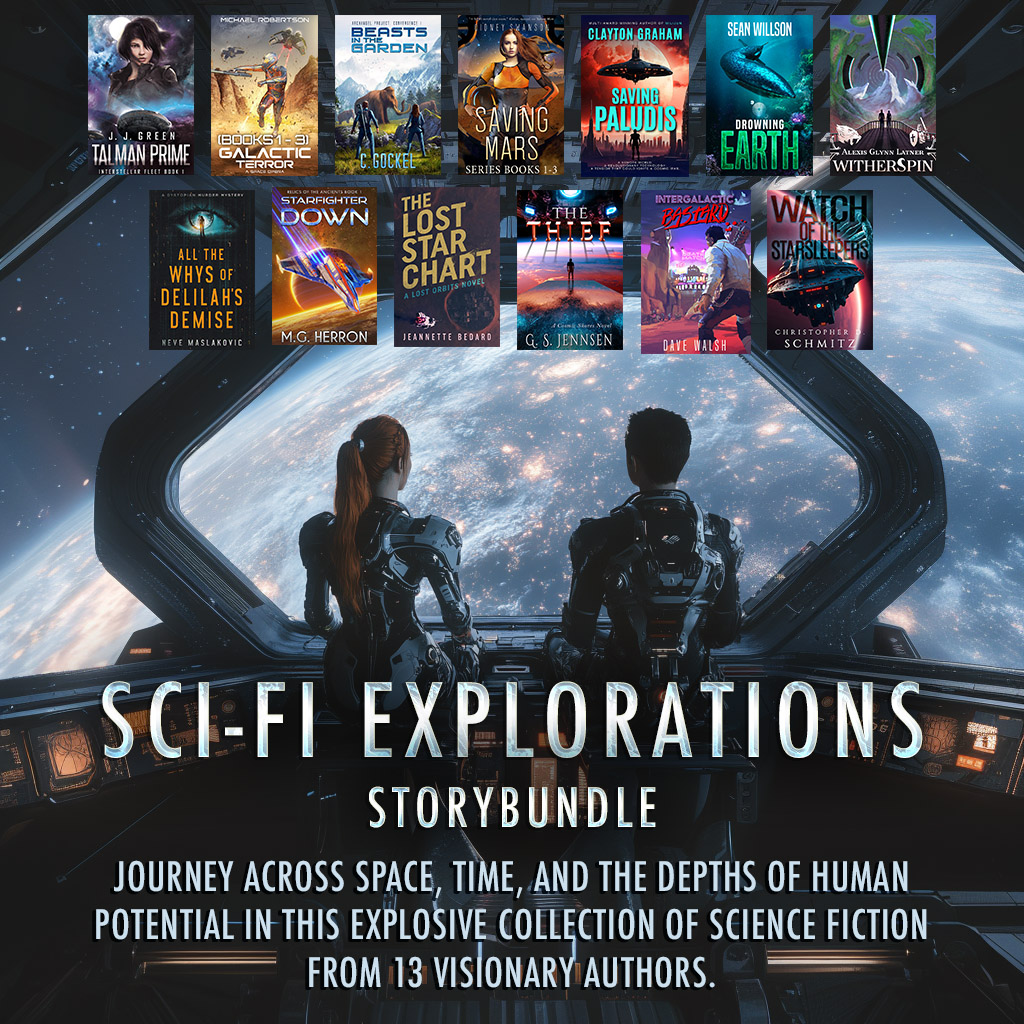
A bit of early 2025 news! My mystery/thriller, All the Whys of Delilah’s Demise, is in a StoryBundle! If you’re not familiar, StoryBundle offers curated collections of ebooks where you can pay what you want and support great authors. The Sci-Fi Explorations Bundle was curated by Carolynn Gockel and features 13 terrific books.
The way it works is, there is a $5 minimum, for which you’ll get the basic bundle of four books. If you’re feeling generous, $20 gets you nine more bonus books — All the Whys of Delilah’s Demiseis one of these. You can also give a portion of your purchase to charity.
The bundle is only available for a limited time, so take a look here for all the details: Sci-Fi Explorations Bundle.
If you’d like, you can help spread the word by sharing this email or Substack post.
Thank you so much for your support, and happy reading!
An update on the book I’ve been working on, which has nicely settled into the title THAT MURDER FEELING. The most recent feedback has been that the story remains confusing in the opening pages and so I’ve been re-writing the early chapters, all of which has me thinking about beginnings.
There’s a lot riding on opening sentences. They need to grab attention, establish the setting, hint at what’s to come. It’s the front door, ajar. Come on in, it says.
I tend to write the whole thing, start to finish, then edit away until the ending’s just right, the middle’s not saggy, the unnecessary stuff has been trimmed away — BUT the first couple of chapters, they’re the last to fall into place. Maybe they’re too wordy, written before I settled into the character’s voice. Or there are threads set in motion that turned out to be unneeded by the time I typed THE END.
Mainly, though, it’s something else. When you write speculative fiction, the reader needs a sense as to what kind of unordinary world lies beyond that front door. The setting, the rules, the stakes. Best delivered not in a wordy information dump, but with a drip-drip of detail that moves things along while leaving some (hopefully intriguing) questions unanswered.
It’s a bit of a balancing act.
The Rube Goldberg Machine
A novel is a chain reaction, a Rube Goldberg machine, a marble run, one thing leading to another.
For example, not a story:
Jane followed the hooded figure into the woods. And then she caught up with it. And then the suspect confessed to being the thief and handed over the jewels in his pocket. And then Jane escorted him to jail.
Story:
Jane followed the hooded figure into the dark woods, treading softly. BUT, distracted by the argument she’d just had with her mother, she forgot to mute her cell phone and a loud ring broke the night silence. And SO, as she fumbled at her pocket to get to the phone, the thief fled off into the maze of trees. Yup, it was her mother, calling again. This was the kind of thing they didn’t teach you in private investigator courses; she’d just finished hers not two weeks ago.
Jane looked up and realized that the thief wasn’t the only one who’d heard the ring. “Mom,” she whispered into the phone, the wolf’s growl raising the hairs on the back of her neck, “I’m going to have to call you back.”
Links that add up to story: But. However. So. Therefore.
(Not and then.)
The next link in the chain? Maybe a nice park ranger who’s good with wolves — call him Rick — makes an appearance to chide Jane for disturbing his animals, and we’re off on a romantic subplot.
The Push
If a story/plot is a chain reaction, made up of but and therefore links, what starts that chain reaction? Put simply, a complication in an initial set-up. In the Rube Goldberg machine, it’s the initial push of the button, the tipping of a lever, whatever it is that says GO before gravity and momentum take over. Jane’s out there following a thief in her first official case and things go wrong: The phone goes off, she fails to catch up with her quarry, there’s a wolf, and she meets Rick.
The later stages of the Rube Goldberg machine have an incoming direction, a natural entrance point, a degree less of freedom. A commitment has already been made, momentum is happening, the story is going over there – catch it and keep going.
But that initial stage of the contraption, the first page, the opening scene, the possibilities are all still there.
In a sense, there’s too much choice. I can do this, or that, oh and other, well, that could work too to get the ball rolling.
The solution, I’ve realized, is to think of the opening scene as not the first stage but some n-th stage, with already moving gears. After all, Jane up there has a life before those woods — for one, there’s that ongoing argument with her mother — even if that’s where we join her story, author and reader alike.
The ball, pushed along by the gears, rolls in from somewhere out of sight of the Rube Goldberg, encounters a sudden gap in its conveyor belt — and drops, engaging the machine.
The previous drafts of THAT MURDER FEELING drifted too far across the keep-it-short line. And so I’m adding a new Chapter One, with more backstory.
To show those gears turning.
Thanks for reading,
Neve
p.s. This month’s promotions! The Narratess Indie Sale is today and tomorrow, the other two are ongoing until the end of April.
This is a cellphone picture I took back in mid-December of Belgrade’s fortress, Kalemegdan. The fortress stands on a ridge above where two rivers, the Danube and the Sava, meet. That’s a view to the south, from along a fortification wall. It’s one of my favorite places to walk around in and explore. Every cobblestone drips with history, starting with Romans in the second century and with many a battle, siege, and transformation since then, layer upon layer.
It got me thinking about a subject with much smaller stakes, at least compared to all that history: the first stone that connects a book to a reader.
Something nudges us into deciding to jump on and spend hours on a reader journey—a journey we know is made up, fictional, just marks on a page. Does the cover pull us in? The Goodreads rating? Word of mouth? Stacks of books beckon as we walk into Barnes & Noble, as do suggestions from Amazon’s recommendation algorithm. So much to choose from!
I tend to jump around in genres as a reader and what I’m in the mood for depends on many a thing. I don’t really read reviews. Some covers catch my eye more than others. I’ll glance at the back-page blurb or the Amazon description. From all that possibility floating by, I lay the first stone. It’s pretty basic: I read the opening paragraph, maybe the one after it too, and some kind of magic happens and that’s how I know I’ll reach for my wallet. I used to do it right there in the bookstore, open to the first page and read. Nowadays I download a sample on my Kindle, which takes all of thirty seconds, and take a look.
Judging a book by a single paragraph seems akin to judging it by its cover. And, yes, I do occasionally end up DNF-ing a book (Did Not Finish). But generally speaking, if I connect to the book from the first page in some undefinable way, I’ll end up reading it to the last page.
I tend to avoid fiction while doing my own writing or editing because sometimes the other author’s rhythm starts to seep in and I find myself spelling honor as honour and so forth. I did, however, just finish a two-week edit of the book I’ve been working on — it’s getting pretty close to where it needs to be; this is the polishing stage — which means that it’s time to be a reader again. I happened to see Sulari Gentill’s The Woman in the Librarymentioned on social media. The cover caught my attention, or maybe it was the title, or the quote at the top, “A treat for readers who love books about books.” Definitely promising. I downloaded a sample and read a bit. Houston, we have a go.
How do you choose your next read? If you received this in your mailbox, you can reply and let me know, or leave a comment below.
Thanks for reading!
Neve
p.s. If you are on the lookout for a book to read, check out these BookFunnel promos:
Over the holidays I’ve been re-reading Douglas Adams’ Hitchhiker’s Guide to the Galaxy; if you haven’t read this sci-fi classic before, I highly recommend it if you’re looking for something lighthearted, original, or just plain funny to read.
Even though we own the hardcovers of the books, I’ve been reading Hitchhiker’s on my Kindle app, which is is always a little odd at first. The familiar opening (“Far out in the uncharted backwaters of the unfashionable end of the western spiral arm of the Galaxy lies a small unregarded yellow sun…”) just looks strange on a digital screen instead of on a crisp white page…but I’ve just about switched all my reading to the Kindle, so no going back there. As it should be — always forward we go.
(The link above takes you to the Kindle edition, all books in the series for $13.99 — not a bad deal for five full length novels.)
The reason I bring up that particular book is that lately I’ve been thinking about the power of books to be whatever you need them to be. This December, I yearned for a lighthearted read and I knew I could find it in Adams’s world. On planes, I like to read more thriller-y stuff. Occasionally I’ll reach for a cozy mystery. Etc. The last non-fiction book I read was the tale of Ernest Shackleton’s ill-fated Antarctic voyage, Endurance. I may have read it during the last week of the election. I may have also skipped over the dog parts.
Books are like that. Whatever you’re feeling, there’s always a book to meet you half way. If my own novels have offered anyone a few hours’ worth of an enjoyable escape into the imaginary…well, that makes me a very lucky writer indeed.
This quote from E. B. White summarizes it well: “Books are good company, in sad times and happy times, for books are people – people who have managed to stay alive by hiding between the covers of a book.”
I know we’re all book lovers here, so I won’t belabor the point, other than to say this: Here’s hoping that 2017 brings you a memorable/just-what-you-needed read or two and many lovely, good things!





 Neve Maslakovic