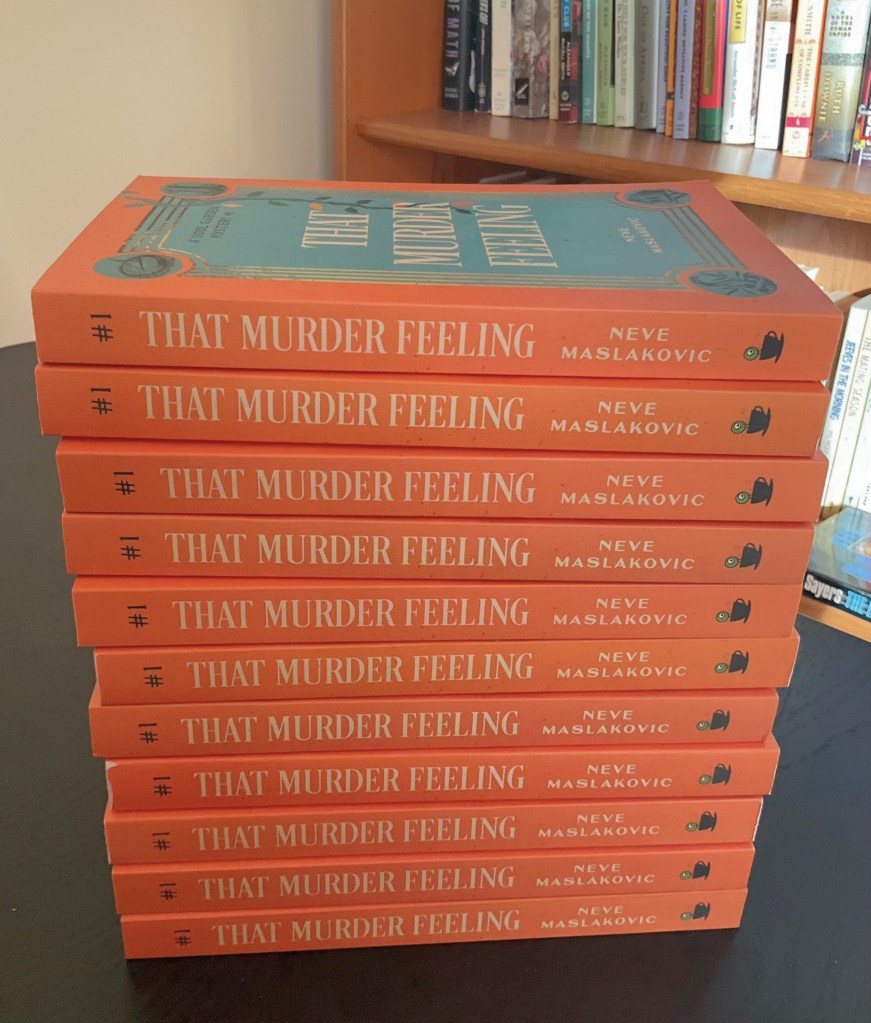
My box of author copies of That Murder Feeling kept being delayed in shipping but finally arrived earlier this month. I love how that orange looks. It’s not quite so bright as in appears in the photo, more of a weathered, pastel hue.
I’ve mailed off copies of the book to the beta readers who kindly provided feedback on the early drafts — if you are on that list and didn’t get your paperback or ebook copy, let me know!
Huge appreciation to the beta readers and a big shoutout also to the book’s developmental editor, Kristen Weber, and its copy-editor, Shannon Page. I’m grateful for their sharp eye and care. Couldn’t have done it without them.
Signed Books
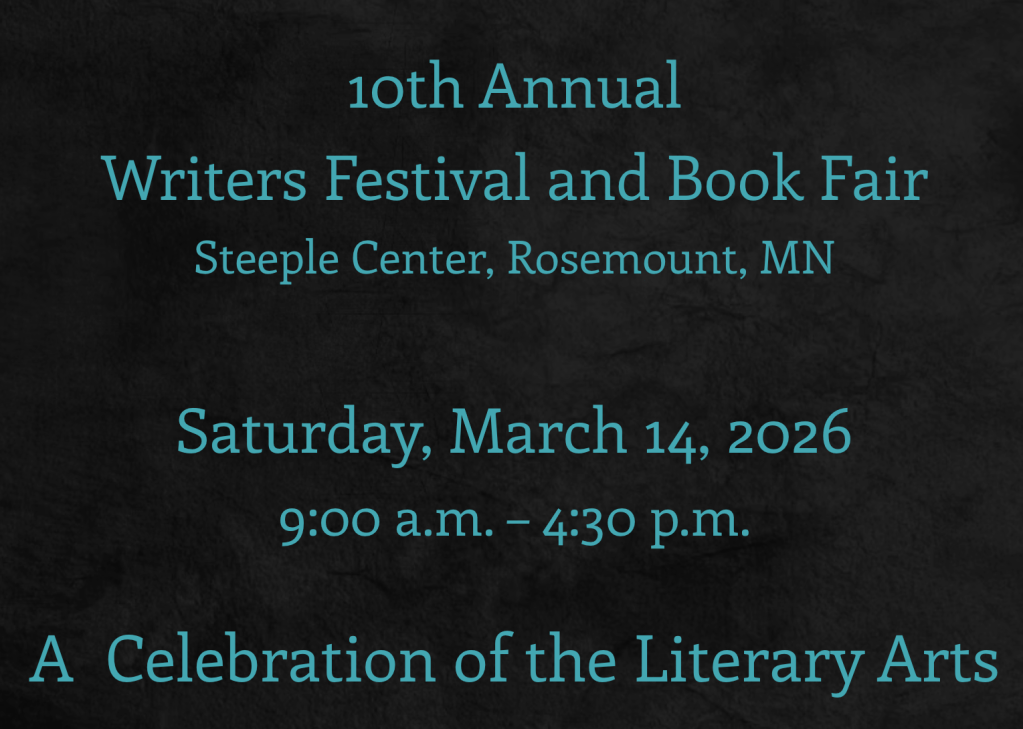
If you’re in the Twin Cities area, I’ll be signing/selling books at the Rosemount Writers Festival, our local book event here south of the Cities. The festival takes place on Saturday, March 14, 2026 from 9:00 a.m. – 4:30 p.m.
Hope to see you there!
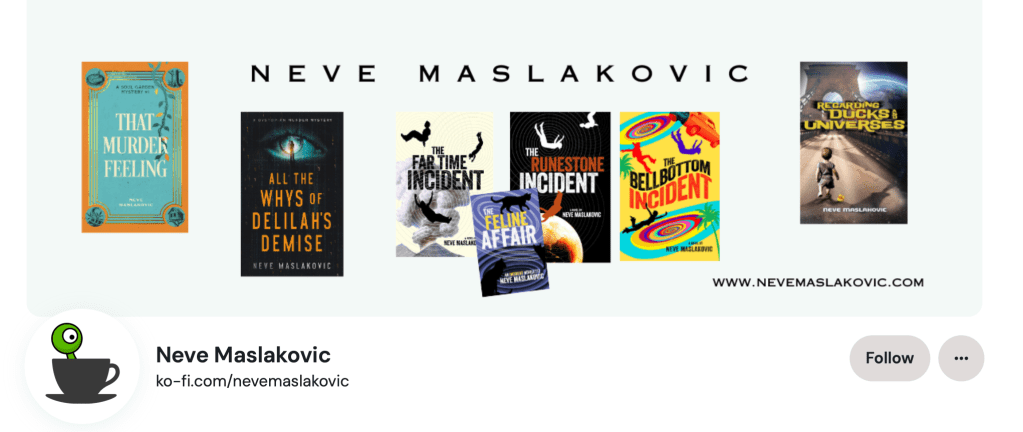
Order signed copies online! If you would like to order a signed paperback to be mailed to you, I’ve set up a Ko-fi page (pronounced “coffee,” as in “buy your favorite creator a cup of coffee.”) I’ll list books there as I happen to have them in stock, which is to say stacked on a bookshelf in my office. The books on the shelf tend to ebb and flow depending on what events/giveaways are going on. At the moment there are three listed on Ko-fi: That Murder Feeling (Book 1 of the new series), All the Whys of Delilah’s Demise (a standalone novel) and Regarding Ducks and Universes(also a standalone novel).
And don’t forget to let me know if you’d like your copy personalized!
What I’m Reading
I’ve been on a mystery reading stretch the last month or two. Here are a couple of books that I enjoyed:
Seven Reasons to Murder Your Dinner Guestsby KJ Whittle. A modern day retelling of Agatha Christie’s And Then There Were None. A page-turner. London as the setting, sharply drawn characters, and an unsettling ending.
Let’s jump right to it, the cover for my new mystery series starter, That Murder Feeling!
This is my sixth book and the first one that belongs more on a mystery shelf than a sci-fi one.
When I started writing it, I knew it would land somewhere between a classic whodunit and something a bit stranger—imagine if Inspector Gamache wandered into a Stuart Turton novel—and that it’d likely be tricky to nail the right tone for cover. And… it was. Ebook Launch handled the design and I think they did a fantastic job of capturing the genre-bending aspect. The color scheme, border, and the four medallions in the corners were locked in early, but we had a devil of a time getting the vine to look JUST right, so much so that I considered dropping it altogether at one point, but felt the cover would be too stark without it. I particularly like how the vine twists around the R with a bit of attitude.
This is the ebook cover, which is always done first. Why, you ask? For the print book, the designer needs to know two things: first, the chosen dimensions (5.5 x 8.5 inches, or 6 x 9 inches, or whatever) and second, the EXACT number of pages in order to be able to calculate the spine width. Even with the text finalized, there’s still the front and back matter to add, which affects the final page count. Same with the book’s interior formatting, from the choice of font to the paper type. (White and cream paper have slightly different thicknesses. The formula, if you’re curious, is Spine Width = Page Count ÷ PPI, where PPI is pages per inch for the type of paper selected.)
Next, here’s a brief introduction to the book:
Meet Rodrick Gray, PI…
Rod Gray has a gift that’s both a blessing and a curse: he can see other people’s emotions. And hear them, touch them — even smell them. He’s given a name to the inside-out realms he encounters, with their strange botanical growths, weather, and creatures: soul gardens. It’s a noisy way to walk through life, but in his small 1980s Minnesota town of Two Lakes, it helps him see what others can’t.
There’s one soul garden he’s never wanted to enter. A killer’s.
Until now. When the town’s richest man is found dead in a blizzard, suspicion lands on Rod’s childhood friend Clementine Baker. Someone sabotaged the victim’s car, stranding him in the woods. There are plenty of suspects, but Rod’s hunting blind — the feeling left behind in the culprit’s soul could be a thorny vine, a lurking serpent that hisses I did it, or something entirely unexpected.
Meanwhile, old feelings for Clem clash with growing doubts about her innocence. The police are closing in, his heart’s getting in the way, and time is running out. Rod must find murder’s mark before his oldest friend pays the price.
The first Soul Garden Mystery. A genre-bending 1980s whodunit of snow, small-town secrets, and a whole lot of tangled feelings.
Preorder links have started to pop up — the ebook will be available on Kindle, Nook, and other retailers. The current list is here and will expand as the book shows up in additional stores.
I’ll be sending out a call for ARC readers in early November, so keep an eye out for updates on my website, or check your mailbox if you’re signed up for my newsletter.
Finally, if you were a beta reader for the book, be on the lookout for a separate email — I’ll be sending them out to ask if you’d prefer an e-book or a signed print book.
Happy January! After the holiday break, I’m back on work on Book 2 of the new series. I’ve been using Aeon Timeline to pull all the series details into one place. The software has proven to be very helpful in keeping it all organized — character names, dates, and so on. I’ve mapped out the outline for the book in it and color-coded things nicely. I would post a screenshot, but it would include story spoilers!
For now Book 1 is still in a holding mode. Publishing does not move fast, and I do want to make sure that the series has the best possible launching pad into the world. I’m hoping to have a more concrete update in the next newsletter, but we’ll have to see.
Sci-Fi Explorations Bundle
Last few days of the Sci-Fi Explorations Bundle! Thirteen authors coming together to offer their books in a themed collection. Includes my futuristic mystery/thriller All the Whys of Delilah’s Demise. Find all the details here.
Emily St. John Mandel’s Sea of Tranquility. Science fiction. I flew through this one. The past, the future, pandemics, time travel. A beautiful and unsettling read.
I’ve also been enjoying Joe Moran’s First You Write a Sentence. Non-fiction. This is not exactly a craft book, more of an ode to the beauty of the written word. A book best read at an easy pace and savored.
Social Media Update
I’ve been poking my head out of my hobbit hole to check out the new social media options. I tried Threads for about 5 seconds, but there’s no way to turn off autoplay for videos, so that’s an automatic no from me. I do like Bluesky, and it’s becoming livelier, with a robust and growing book community, so much that I keep wanting to call it Booksky. It has the feel of Twitter before it was X, with a similar interface and a 300-character limit for posts. Like Mastodon, there are no ads on Bluesky (though that may change down the road) and it has some cool, unique features like Starter Packs.
An update on the book I’ve been working on, which has nicely settled into the title THAT MURDER FEELING. The most recent feedback has been that the story remains confusing in the opening pages and so I’ve been re-writing the early chapters, all of which has me thinking about beginnings.
There’s a lot riding on opening sentences. They need to grab attention, establish the setting, hint at what’s to come. It’s the front door, ajar. Come on in, it says.
I tend to write the whole thing, start to finish, then edit away until the ending’s just right, the middle’s not saggy, the unnecessary stuff has been trimmed away — BUT the first couple of chapters, they’re the last to fall into place. Maybe they’re too wordy, written before I settled into the character’s voice. Or there are threads set in motion that turned out to be unneeded by the time I typed THE END.
Mainly, though, it’s something else. When you write speculative fiction, the reader needs a sense as to what kind of unordinary world lies beyond that front door. The setting, the rules, the stakes. Best delivered not in a wordy information dump, but with a drip-drip of detail that moves things along while leaving some (hopefully intriguing) questions unanswered.
It’s a bit of a balancing act.
The Rube Goldberg Machine
A novel is a chain reaction, a Rube Goldberg machine, a marble run, one thing leading to another.
For example, not a story:
Jane followed the hooded figure into the woods. And then she caught up with it. And then the suspect confessed to being the thief and handed over the jewels in his pocket. And then Jane escorted him to jail.
Story:
Jane followed the hooded figure into the dark woods, treading softly. BUT, distracted by the argument she’d just had with her mother, she forgot to mute her cell phone and a loud ring broke the night silence. And SO, as she fumbled at her pocket to get to the phone, the thief fled off into the maze of trees. Yup, it was her mother, calling again. This was the kind of thing they didn’t teach you in private investigator courses; she’d just finished hers not two weeks ago.
Jane looked up and realized that the thief wasn’t the only one who’d heard the ring. “Mom,” she whispered into the phone, the wolf’s growl raising the hairs on the back of her neck, “I’m going to have to call you back.”
Links that add up to story: But. However. So. Therefore.
(Not and then.)
The next link in the chain? Maybe a nice park ranger who’s good with wolves — call him Rick — makes an appearance to chide Jane for disturbing his animals, and we’re off on a romantic subplot.
The Push
If a story/plot is a chain reaction, made up of but and therefore links, what starts that chain reaction? Put simply, a complication in an initial set-up. In the Rube Goldberg machine, it’s the initial push of the button, the tipping of a lever, whatever it is that says GO before gravity and momentum take over. Jane’s out there following a thief in her first official case and things go wrong: The phone goes off, she fails to catch up with her quarry, there’s a wolf, and she meets Rick.
The later stages of the Rube Goldberg machine have an incoming direction, a natural entrance point, a degree less of freedom. A commitment has already been made, momentum is happening, the story is going over there – catch it and keep going.
But that initial stage of the contraption, the first page, the opening scene, the possibilities are all still there.
In a sense, there’s too much choice. I can do this, or that, oh and other, well, that could work too to get the ball rolling.
The solution, I’ve realized, is to think of the opening scene as not the first stage but some n-th stage, with already moving gears. After all, Jane up there has a life before those woods — for one, there’s that ongoing argument with her mother — even if that’s where we join her story, author and reader alike.
The ball, pushed along by the gears, rolls in from somewhere out of sight of the Rube Goldberg, encounters a sudden gap in its conveyor belt — and drops, engaging the machine.
The previous drafts of THAT MURDER FEELING drifted too far across the keep-it-short line. And so I’m adding a new Chapter One, with more backstory.
To show those gears turning.
Thanks for reading,
Neve
p.s. This month’s promotions! The Narratess Indie Sale is today and tomorrow, the other two are ongoing until the end of April.
I’ve been playing with ChatGPT as we leave 2023 in the rear-view window and embark on the shiny new highway of 2024.
I like new technology, generally speaking. (Frankly, I wouldn’t say no to a robot assistant who’d decide what we’re having for dinner, remind me of appointments, proofread, and walk the dog on rainy days.) And let’s face it, like everything from the wheel to mobile phones, Artificial Intelligence is here to stay.
So, What Is ChatGPT?
Despite the name AI, models like ChatGPT do not really think for themselves. ChatGPT is a deep learner. It was trained not by being told the rules of the English language — it being impossible to come up with such rules, as a language is a complicated thing — but by being fed pages and pages of example text. That’s what the P in the name stands for, pre-trained. (Its full name is Chat Generative Pre-trained Transformer; you’ll also come across the term Large Language Model, LLM for short.) The model digested it all, looked for patterns, incorporated user feedback, and acquired the ability to predict the next string of words in most contexts. ChatGPT can carry on a dialogue and generate text on various topics. It’s a fancier version of those annoying chatbots that pop up on retail sites.
There are concerns. One is whether the training phase of ChatGPT violated copyright, overstepping the bounds of fair use as the model absorbed Internet articles and books available online. There are lawsuits. Another concern is that since the way it works is a bit of a black box, there’s a risk of accidental plagiarism. The model doesn’t cite sources.
AI as a Ghostwriter
You’ve probably already read news articles written by AI without realizing it. Some fiction writers have jumped on the bandwagon, using ChatGPT or other LLMs to generate a “zero draft”, which they then edit into something usable.
So if a novel is your end goal, how does it work?
My experiment began with me signing up on the OpenAI website. I stuck to the free version, ChatGPT. (There’s also a more sophisticated version, ChatGPT Plus, also known as GPT-4. It’s $20 per month.)
The interface is pretty straightforward. It’s very good at some things, I discovered at once. You can use ChatGPT as an online thesaurus, without the annoying ads. It excels at translating, at least between the two languages I know, English and Serbian.
But how about that novel writing?
Well, you can enter a prompt. For instance, I went with this one: “Chat, write the opening paragraph of a mystery. A woman breaks into a library after hours and encounters another intruder.”
This was the result:
Emma’s heart raced as she picked the lock on the library’s side entrance. The moon cast a silvery glow over the deserted town, and a slight chill hung in the air. The rusty door creaked open, revealing the dimly lit interior of the library, its shelves holding the secrets of countless stories. Emma had a mission—a clandestine rendezvous with a hidden manuscript that whispered of answers to the questions plaguing her restless mind.
Silent as a shadow, she moved through the labyrinth of bookshelves. The carpet muffled her steps, and the only sound was the soft shuffle of pages in the breeze she created. She reached the secluded corner where the coveted manuscript was rumored to reside, anticipation pulsating through her veins.
As Emma’s fingers brushed the edge of an old, leather-bound book, a noise disrupted the tranquil atmosphere. Startled, she turned to face an unexpected intruder stepping out from the darkness. A man, his eyes reflecting the same surprise that mirrored in her own. In that tense moment, the library’s hallowed silence shattered, replaced by the palpable uncertainty of two strangers caught in the act.
“Who are you?” Emma’s whisper cut through the stillness, her eyes narrowing in suspicion. The man hesitated, his gaze shifting between her and the manuscript in her hand. The library, once a sanctuary of solitude, had transformed into the stage for an enigmatic encounter. The answers Emma sought were within reach, but the mystery had just taken an unforeseen turn.
ChatGPT came up with that in about ten seconds. It’s…not great? Overwritten, flowery, lacking in specifics and grounding details.
I did a few back and forths, requesting that ChatGPT alternate between short and long sentences, add sensory details, and have the intruder be someone from Emma’s past. Here is what it came back with:
Emma deftly worked the lock, slipping into the moonlit library. The scent of aged paper and wood polish filled the air as she stepped into the quiet expanse. The shelves loomed like silent sentinels, their secrets veiled in shadows. Her focus was laser-sharp on a hidden manuscript, its pages rumored to hold the answers to the questions that tugged at her consciousness.
Silent as a whisper, Emma navigated the shelves, the rough texture of the carpet beneath her feet absorbing the sound of her movements. Her fingers trailed over aged spines, feeling the cool embrace of leather and the slight roughness of worn fabric.
A noise shattered the library’s hush, a figure emerging from the darkness. Their eyes met, mutual surprise etched on their faces. The library’s tranquility morphed into a stage for a clandestine encounter.
“Who are you?” Emma’s demand sliced through the silence. The man hesitated, eyes darting between her and the manuscript. The air crackled with uncertainty, the unfolding mystery taking an unexpected turn.
As recognition flashed across Emma’s face, it wasn’t just any intruder—it was someone from her past. The past she thought she’d buried, a door creaking open to memories she had long tried to forget.
The library held not only the promise of answers but also the specters of her own history.
I still want to take a red pen to this, but at least now we’re getting some tension.
I stopped there. But could the generated page have been reworked into a decent story opening? Sure. With time, ChatGPT would train me in the kind of instructions it needs and it would spit out text closer to my own style of writing. And presumably the paid version of ChatGPT yields better, even faster results.
Thing is, it seems to me that I’d be trading away the fun part of writing, for speed. Exchanging the playground of creativity for prompt mastery. Foregoing the hard work that makes the work my own creation and not a machine’s. The earning — the journey — is not only part of the process. It’s the whole game.
And there’s something else.
Rereading what ChatGPT wrote above, it strikes me that what’s missing most of all in its output is seasoning. The text it provided is bland. A lukewarm airplane meal. Wonder Bread, still in the package.
Let’s Talk Bread for a Minute
These days, since my husband is gluten free, we follow a recipe from this cookbook, Gluten-Free Artisan Bread in Five Minutes a Day. The title is misleading. Five minutes is how long it takes to transfer the dough you’ve already prepared and stored in the fridge into a baking pan and shape it into a loaf. Making the dough, well, that involves yeast, 3-4 kinds of flour, and about three hours. The baking adds another 45 minutes. But you know what? The end result tastes way better than store bought gluten free bread.
Another bread I know how to make is traditional Serbian pogacha. That one takes about three hours, too. Yeast, kneading, an egg wash at the end. My mother’s recipe. Baked in a round pan, it’s particularly good when paired with prosciutto and a bit of feta cheese.
Image: Klaus Nielsen from Pexels.
Woven into home-made bread are time and effort, the quirks of the chef and her kitchen, a bit of history and artistry even.
And so it is with books. In my time travel series, Minnesota plays a role because that’s where I live; Pompeii, because I’d always wanted to see it. A novel of mine might lean more towards mystery or closer to sci-fi/speculative…or it might hover right there, on the sharp divide. We make what we make.
Nothing wrong with Wonder Bread. It’s been around since 1921, it’s soft, conveniently pre-sliced, always the same, and comes in a familiar red-blue-yellow package.
What would be wrong is if I tossed it into my grocery cart, drove it home, took it out of its wrapping, and pretended it just came out of the oven.
The Bottom Line
Look, I’m not gonna sit in front of my MacBook Air, with its spell-checker, thesaurus, and Wikipedia at my fingertips, and argue that the One True Method of Novel Writing is chiseling into stone letter by letter. Will there be a time down the road when the models improve, are trained ethically, are as common as word processors and prompt mastery an art of its own, the pointing of a camera into a landscape of words, and only dinosaurs refuse to use the technology? Possibly. I can see the appeal of a chapter draft served up in a blink of the eye.
But for now? For now, I’ll stick to the old way.
My books will be of the artisan kind. I’m not a very fast writer, so the production time will be long. There shall be typos. Odd bits of humor. Peculiarities due to English being my second language. Random facts I happened to be in possession of will make their way into the story, as will my inner-world concerns, dreams, opinions. A novel is an opinion piece. Art. A playground. That’s the fun part, after all.
By the way, I asked ChatGPT to come up with a title for this post and it suggested Navigating the Write Path: A Fiction Writer’s Skepticism on AI and Novel Craftsmanship.
It was one of ten options it provided for the title. They were all long and they all had colons. ChatGPT likes colons. It’s not an intelligence, it’s not doing it on purpose — but what it is doing is offering up its own quirks in the place of mine.
The title says it all. Book 1 of the new speculative mystery series is done and looking for a couple of beta readers!
If you’re unfamiliar with the term, a beta reader is a generous soul who volunteers to read a pre-publication draft of a novel and provide feedback. (Alpha readers see the manuscript at an early, still-in-development stage; beta readers see a close-to-publication draft.)
If Your Problem is Murder is a speculative mystery set in 1985, the first in an intended series. (Yup, this is the book formerly known as Dogwood, the one I was determined to find a one-word title for. As you can see, it…didn’t work. Maybe I’m just fated to have long titles?) The book is 77K words, about 275 pages. Here’s a brief pitch: In this small town mystery series, Redmond Marrs, a life coach with a big secret, tackles the personal problems of residents—all the way up to murder.
Let’s do a quick Q&A:
Does a beta reader need any previous experience?
No, just a love of reading!
What kind of feedback will be expected?
I like to keep it simple. The main question I have for you is this: Is the story working? If not, which parts?
The important thing to remember is that you can’t hurt my feelings. I’m eager to make the book be the best it can be. You would be helping me do that! The manuscript has not been copyedited yet, so at the very least you should expect to encounter typos and the odd goof (timeline or factual) here and there.
What do I get in return?
A signed copy of the book upon publication and my eternal gratitude.
What’s the timeline?
I can email you the manuscript immediately. I would need to receive your feedback by June9.
What’s the next step?
If this sounds like something you might be interested in, great! If you’re reading this in my newsletter, go ahead and respond to the email and let me know your preferred format. The options are .docx, PDF, epub, mobi. I can also do Google docs. I’ll reply with further details and the manuscript.
If you’re seeing this on Goodreads or elsewhere, sign up for my newsletter here to follow along with the latest writing and book news. As I always, I can also be contacted via the form on my website.
Happy New Year! For me, January 1 always brings with it the feel of a crisp new notebook. Pages yet to be written. Moments to be grabbed, new things to be learned, adventures and struggles awaiting just around the corner.
Blue skies ahead, what’s over the horizon as yet unknown.
The ocean water picture is one I took from my cabin on the Writing Excuses Workshop and Retreat cruise, this past September in the Western Caribbean. It was an extraordinary experience. I’d never been on a cruise before, or the Caribbean, or a writer’s retreat. I can happily report back that I met and got to converse with some wonderful people, attended group dinners in a grand dining room, sat in on lectures by authors Brandon Sanderson and Margaret Dunlap and agents DongWon Song and Seth Fishman, went on three lovely excursions, watched a nighttime lightning storm from the ship’s railing, visited Rose and Jack’s “I’m king of the world” spot on the bow, and never got seasick!
I had planned to do a full edit of Book 1 of the new mystery series on the cruise, somewhat optimistically in retrospect. With all the other activities, I managed to get through about 150 pages, so just about half. I did attend an “unlocking” session, which helped clarify some issues I had been struggling with, mainly having to do with the big arc of the series.
By mid February, there should be a near-final draft of the book. The working title, Dogwood, is not here to stay, alas, but I’ll leave the unveiling of the new and improved title for a post down the road. When I’m happy with the manuscript, I’ll send out a call for beta readers. I’ll give out more details then, but basically the way it would work is I’d provide a Word document (or other format) with the 300-page manuscript and brief guidelines as to the type of reader feedback I need. In return you’d get a deeper look into my writing process than this newsletter, my eternal gratitude, and a copy of the book upon publication in your preferred format, ebook or print. Be on the lookout for the email if you’re interested!
On a social media note, going forward I’ll be taking a break from the merry-go-round that’s Twitter. I’m trying out Mastodon — you can find me in the Wandering Shop, a community of science fiction and fantasy readers and writers. I’m @neve there (@neve@wandering.shop). So far I’m finding it welcoming and less adversarial than the ‘birdsite’. I’ll still be on Twitter, just not as much.
First, a welcome if you’ve recently found your way to this newsletter via my website, or a Voracious Readers Only giveaway, or the ArtWorks parking-lot fair back in September. Very happy to have you here!
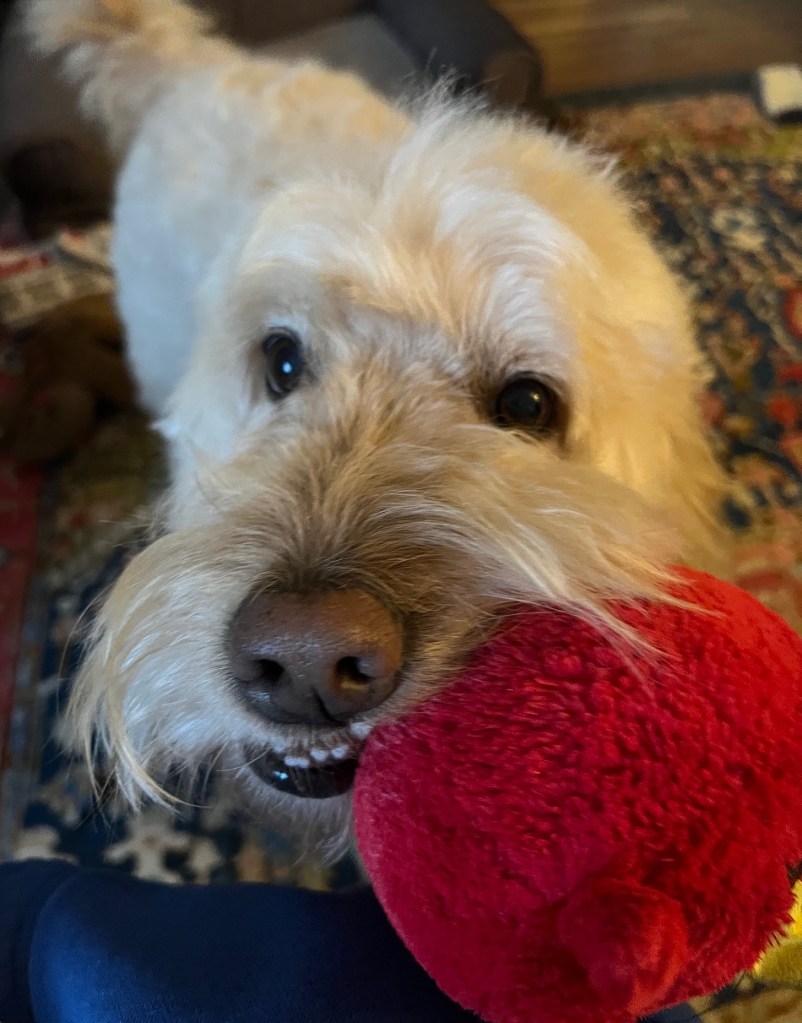
This past year has gone by kind of fast, and yet when I think back to January it seems like a long time ago. A side effect of a pandemic year that was weird and strange for everyone? Our goldendoodle (Grif, age 3 1/2) agrees that time is a fluid concept — each spring he seems to completely forget all about snow once it melts away and is freshly surprised (and a little outraged) by its appearance when winter rolls around once again. Above is a picture of him frolicking during our first big snowfall of the year (17 inches!). It took him a couple of days to accept the change in his backyard. He checked the neighborhood streets, too — the white stuff was everywhere on his walks — and then he went back to doing what he does best, enjoying himself. He’s a carpe diem kind of dog.
Moving on, a writing update! I’ve been working on Book 1 of a new speculative mystery series. The current word count is just about 59,000 (out of an estimated 75,000 words) which makes it seem as if I’ll soon be nearing THE END, but really that’s just the messy first draft. Next comes the shaping stage. Shifting, adding, taking scenes out, rewriting chunks, fiddling with the setting and the characters, polishing dialogue, pulling tight the strings of the story. I’ve set myself the challenge of a one-word title for this one. (I picture my cover designers pulling at their hair… She has a looong name AND she wants a long title?? Regarding Ducks and Universes…. All the Whys of Delilah’s Demise… Argh!) I’m sure I’ll change my mind a few more times about the naming of the book, but the working title at this point in time is (ta-da!) Dogwood.
Finally, I have a question for you. What three books that you read in 2021 were your most enjoyable/memorable (or just happen to be on your mind as you read this)? It’s fine if the books didn’t actually come out in 2021, the publication date doesn’t matter, there are no rules here really, other than that I suppose they should be in the one of the categories that have brought us all here: speculative fiction and mystery… Could be a sci-fi mystery. Could be just mystery. Or just sci-fi. It’s all good.
To start us off, here are three books that I read this past year that I quite enjoyed:
The Psychology of Time Travel by Kate Mascarenhas. A thought-provoking, intricate, interlaced story. I found it quite unusual and interesting.
Project Hail Mary by Andy Weir. In some ways an old-fashioned sci-fi tale. If you liked The Martian, you’ll enjoy this one.
The Nils Shapiro series by Matt Goldman. Mysteries set in Minneapolis. There are four of them so far and I’ve read the first three. Page-turners with snappy dialogue and local color.
There you have it. You can reply to this email with your 3 books (or comment below if you’re reading this on my website) and I’ll include a list of everyone’s recommendations in the next newsletter.
Happy holidays! Wishing everyone a safe and happy 2022!
If you receive these updates via email, as you can see, the newsletter has a new format! It’s now getting to you by way of Mailchimp rather than Feedburner. With any luck, the transition will go smoothly and the email won’t wither away in your spam folder…or, if it did go into spam, you’ve rescued it and are now reading this. As a side note, if the images aren’t displaying correctly, there is a link at the top with an option to view the email on the web. My thanks to everyone who posted a review of The Feline Affair on Amazon, Goodreads, and other sites! Reviews help other readers find the story, and Amazon reviews are particularly important because without a certain number of them the site’s recommendation/also-bought algorithms won’t kick in. (Exactly how many reviews it takes no one outside of Amazon seems to know.) So whether you liked The Feline Affair, or thought it was just OK, or frankly not very good at all… please let other Amazon customers know by writing a line or two about the book.
In other news, I’ve been hard at work on a standalone novel (no title yet). This one is a little different in that it’s decided that it wants to be written not in the traditional past-tense narration (Once upon a time, there lived a King in the small kingdom of Wilderia…) but in the present tense (The king of the far-way planet of Wilderia sits on his throne. An unexpected visitor enters. The king, dispensing with a thousand years of protocol, rises to his feet in terror…) Examples of present-tense novels you may have read are The Time Traveler’s Wife by Audrey Niffenegger and The Hunger Games by Suzanne Collins. The immediacy of the present tense works well for those (quite different) books and I’m finding that’s the case for my new novel as well. So it’s a little bit of an experiment, but hopefully a good one. (Also, so there’s no confusion—there are no kings in the new book!)
Finally, I leave you with a couple of photos of beautiful Minnesota autumn, taken at Applewood Orchard, just south of us. Most of the apples had been picked over this late in the season, but our small group–husband, son, and family friends–quite enjoyed the pumpkin-shaped corn maze!
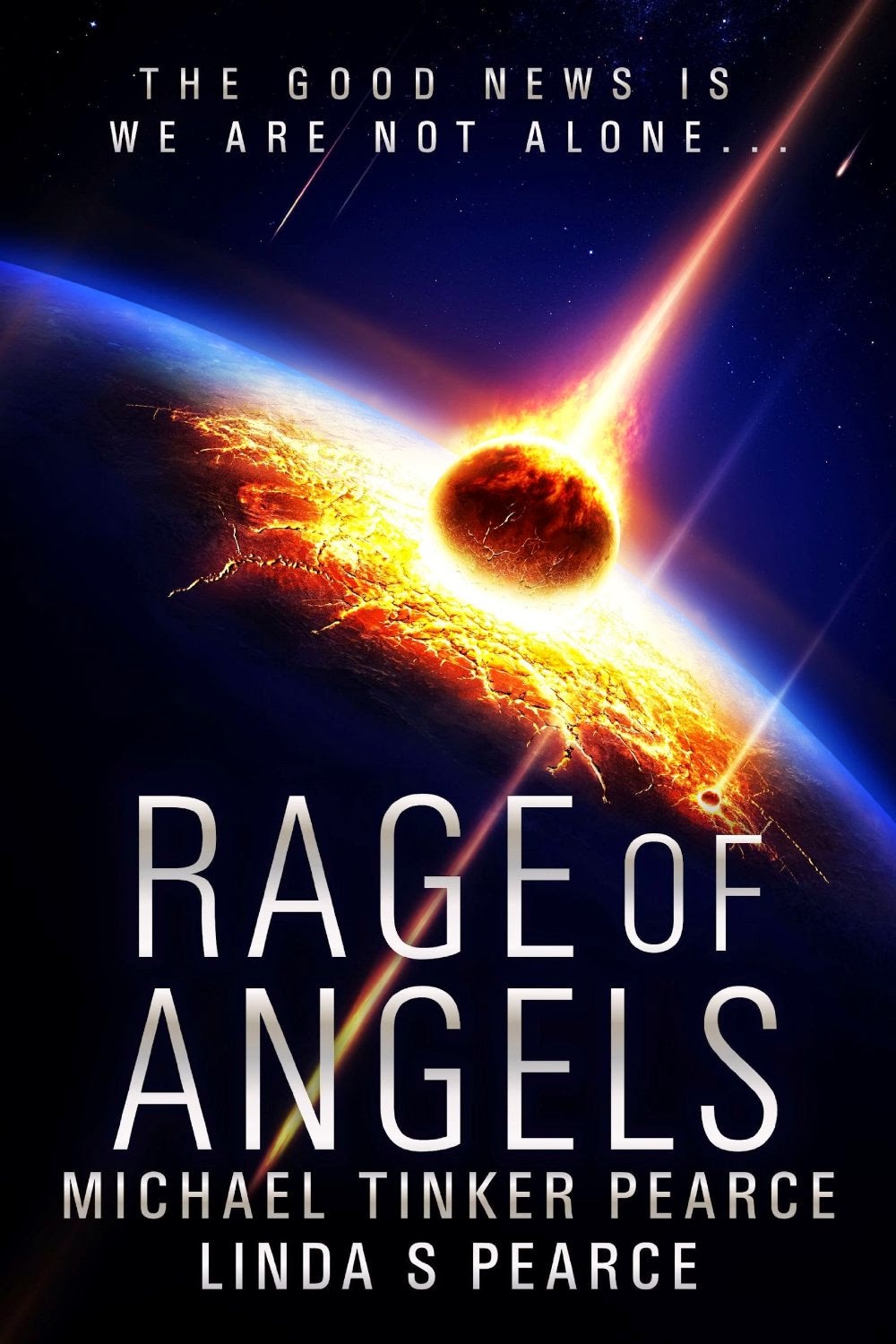
Today on the blog we have one half of the writing duo of Michael Tinker Pearce and Linda Pearce. The couple’s second novel, Rage of Angels, a military science-fiction story, is now available on Kindle. Michael stopped by today to talk about fictional alien invasions of Earth, and how they often seem to involve aliens that aren’t exactly the brightest bulbs in the galaxy. Read on:
Earth is maybe the luckiest planet in the cosmos. Sure, we keep getting invaded but the invaders are always, well, stupid. From the very first alien invasion story, H.G. Wells’ War of the Worlds,the prerequisite for attacking Earth seems to be that you must be dumb. Wells’ Martians had overwhelming technical and military superiority and they steamrolled us. It seemed like the perfect plan… except they forgot to filter their air-supply, caught colds and died.
In almost all books and movies on the topic the invaders make stupid, elementary mistakes. In Pandora’s Planet the aliens invaded despite the fact that they were less technically advanced than we were, and even holding the orbital high ground was almost not enough to insure victory. In Independence Day the aliens had never heard of network security. In Battle: LAthe aliens were doubly stupid- they designed their entire offensive around a single point of failure and they invaded for what? Water, made from some of the most common elements in the universe and readily available in space. Don’t get me wrong, I enjoyed all of these books and movies. I just had to work extra-hard to suspend my disbelief.
The thing is that smart aliens almost certainly wouldn’t attack our planet unless they knew they would win. The energy and effort to cross interstellar space is just too great and expensive to bother otherwise. Kudos to Larry Niven and Jerry Pournelle for figuring out why a race that might not win would attack in Footfall, a great book and well worth reading even if it is a little dated now. Of course even his aliens expected to win, and would have but for one of the greatest and most entertaining ‘Hail Marys’ in science fiction.
So what if smart aliens attacked Earth? What if they had a good reason to do so and had a good plan that capitalized on their strengths? That was the foundation of the idea for Rage of Angels. The answer, it turned out, is ‘We’re screwed.’ Two thirds of the way through the book we realized that we couldn’t figure out a believable way for the people of Earth to win. Um… problem there…
We did eventually work out a satisfactory and believable resolution, did a lot of math to insure that it would work and finished the novel, but it was touch-and-go for a while. It turned out that even our aliens weren’t quite as smart as we’d thought, but no spoilers.
We’re lucky in that we live in the best time to be a writer in human history. Especially a science-fiction writer. Not only do we have the ability to self-publish and reach a world-wide audience but we have the greatest research tool in the history of the world at our fingertips: The internet. Whether it is the history of the Viking Era or the maximum effective range of an M16A2 rifle it’s all there for the asking. And then there is Google Earth… Almost every location in Rage of Angels is a real place. As a writer I can look for the perfect location for my action, swoop in and get details of the terrain, elevation etc. Mind you, you don’t have to include that information in the story, but even if you don’t it allows you to visualize the action and describe it more accurately. Yes, you have to be careful and work from multiple sources when using the internet, but it’s still an amazing tool.
There is another reason that this is a great time to be a science-fiction writer. There are actually scientists at NASA and around the world working on Warp Drive and related physics. Seriously. We may well be only decades away from a faster-than-light space drive. Hilariously it works remarkably like the warp drive in Star Trek. What this really means to me of course is that I can use warp physics in my stories and still call them ‘Hard Science.’ Fantastic!
As interesting as the science may be it’s the characters that drive the story. Male or female, human or alien. Memorable, sympathetic and likable or coldly sociopathic and calculatedly evil. Without the characters it just isn’t going to happen because in the end it comes down to people. What ever else may change I think that’s likely to remain true for as long as people tell each other stories.
******
Michael ‘Tinker’ Pearce lives in Seattle with his wife and co-author Linda. He got the nickname ‘Tinker’ in the 1980’s when he was at various times a soldier, college student, a bodyguard, a private investigator, a meat-carver at a restaurant, a police officer, an illustrator, heavy equipment operator, competition shooter, cover-copy writer, outlaw road-racer, Drill Instructor Candidate, receptionist, executive assistant to the heads of corporate banking at Citycorps, Tobacconist, courier for a currency exchange etc.
He finally settled down to become a knife and sword maker, specializing in the blades of medieval Europe and the Viking Era. He is the author of ‘The Medieval Sword in the Modern World,’ and the designer of the CAS Iberia Tinker Line of medieval swords and trainers. He is a trained theatrical fighter and choreographer, and a student of Historic European Martial Arts. He co-authored the Foreworld novella ‘The Shield Maiden’ and the couple released their first novel ‘Diaries of a Dwarven Rifleman’ in early 2013. They released a sequel novella, ‘Diaries of a Dwarven Rifleman: Rear Guard’ in September 2013. Their second Foreworld Novella ‘Tyr’s Hammer’ was published in October 2013.
The couple has just released their second novel, ‘Rage of Angels,’ a hard-science military science-fiction story based on the events in ‘The Killing Machine’ and ‘What Happens in Dubai.’ Future projects include the full-length sequel to ‘Diaries of a Dwarven Rifleman,’ ‘Lord of the North’ and the Contemporary Fantasy “The Gray Man’s Journal.’










 Neve Maslakovic