Categories
Uncategorized

Pics from Uncle Hugo’s

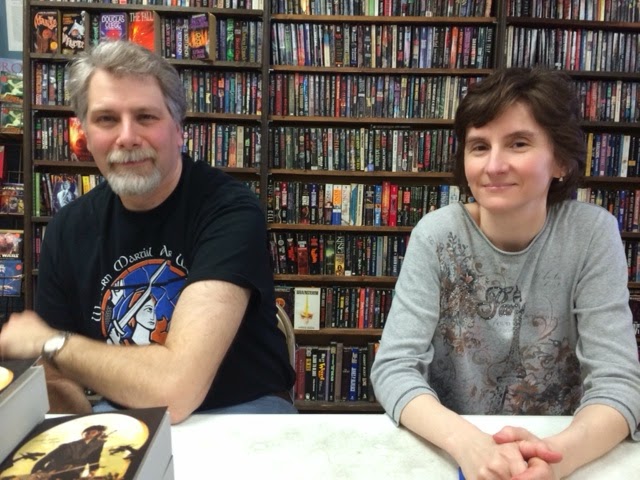
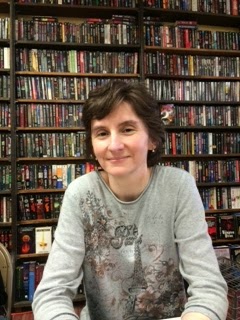
My thanks to everyone who came to Uncle Hugo’s this past Saturday or preordered books — I had a great time, met some lovely people, and even got to sign a T-shirt! Here are some pictures:


Uncle Hugo’s, and next to it, Uncle Edgar’s.

One of us is Doug Hulick.

There are a lot of books behind me. There are a lot of books at Uncle Hugo’s.

I’m signing a T-shirt. My nose looks big for some reason — it must be the (ahem) angle.

The view from behind the signing table.
Ironically, I didn’t get any pictures of me signing an actual book. I did sign whatever was left in stock, so if you didn’t get a preorder in in time, there are still a few books available.
Cheers,
Neve

Categories
Uncategorized

News This Second Week of May

Finally some nice weather here in the Twin Cities – sixty degrees and (partly, but we’ll take it) sunny. The flowers aren’t blooming yet, but there’s hope.

There are various May promotions going on for my series starter, The Far Time Incident, so if you’re in the mood for a time-travel mystery, it’s a great time to pick up the audiobook (wonderfully narrated by Mary Robinette Kowal and $6.95 for Audible customers until May 10) or the ebook ($1.99 on Kindle until Memorial Day) or a print copy ($7.99 until May 15 on Amazon). In the UK, both The Far Time Incident and The Runestone Incident are £0.99 on Kindle for all of May.

Also, a reminder that this Mother’s Day weekend, I’ll be at Uncle Hugo’s. If you drop by the bookstore this Saturday, the 10th, you’ll find Douglas Hulick and me at the table by the door from 1-2 pm signing books. Hope to see you there.

Then, on Sunday, my guys will probably take me out to brunch somewhere. Happy Mother’s Day to all the moms out there!

Neve

Categories
Uncategorized

Meet 47North Author Melissa F. Olson

Today I welcome fellow 47North author Melissa F. Olson to the blog! Melissa writes urban fantasy — her short story Sell-By Date, an introduction to her Scarlett Bernard series, releases today. Read on:


Neve: Tell me about your books, Melissa – what drew you to writing an urban fantasy series?

Melissa: I’ve been an urban fantasy reader since I was twenty-three and my baby sister first passed me a copy of Rob Thurman’s Nightlife. As I was beginning to write, however, I told myself that I would never write in this, the genre I love the most, unless I could think of an idea that I hadn’t seen before. I went on my merry way, writing mysteries, and then it happened: I had the idea. I came up with the concept of a null, a person who can negate magic within a given space around her. I hadn’t seen it before, and I started to get very excited, and things took off from there.

N: How did signing with 47North come about? 

M: I did try to get published the “traditional” way first – I had an agent who shopped DeadSpots around to everyone, and everyone gave me one of two answers: either they loved the book but the UF market was too saturated, or they loved the book but it would require some development editing, and they just didn’t have time to put that much work in a new author just then. I was considering publishing DeadSpots myself when my agent had one last meeting– with 47North. 


N: Do you outline your books in advance or are you the fly-by-the-seat-of-your-pants kind of writer?

M: The first three books I wrote were all fly-by novels: I started out knowing the first chapter, the basic arc, and usually the last scene. It turns out, however, that stupid editors like having these things called outlines in advance so they know what to expect from your book. The nerve! Now that I’m published I’ve been trying really hard to do the outline work in advance – but small things always end up changing along the way. 

N: How about this winter we’ve just had, conducive to writing or what? Speaking of which, where do you get your best writing done — home, coffeehouse, other?

M: I write best in a quiet building away from my children, which usually means a coffee shop. Sometimes my babysitter takes the girls on adventures and I get to write in the privacy of my own home, but mostly it’s coffee shops, libraries, etc. This winter was a tough one for having to get in the car and go somewhere, but I’d rather it was me than my little kids.

N: Favorite quote from one of your own books? 

M: Ordinarily I would agonize over the question, but there’s one line that I’ve had to fight three different copyeditors to keep, so I’ll pick that one. From Hunter’s Trail (Sept 2): 

The second time there was no mistaking it: a long, deadly-sweet howl that was snatched up by the wind and braided through the tree line.


N: I saw that you lived in California for a while, same here. Everyone talks about the lovely California climate but really, it’s the food, isn’t it?


M: OMG YES. I’ve taken two trips back to LA since I moved back to the Midwest, and both times it was pretty much Melissa’s Culinary Tour of the City. Although after this winter, it’s definitely also the climate. Every time I looked out my window and saw two feet of snow, I wracked my brain trying to remember why I ever moved back to the tundra.

N: Just because I’m curious about how other authors function — do you read your Amazon and Goodreads reviews?

M: Nope, not really. I don’t do anything with the Goodreads reviews, but I keep an eye on the number of Amazon reviews, and when a new one comes in I look at the rating. I might read it if it’s four or five stars, but I general stay away. When I get a great review, I feel pleased for three minutes and then forget about it. When I get a terrible review (and thankfully, there haven’t been many) it haunts me for days like my own personal rain cloud. I’m a classic middle child that way.

N. Best thing about the writing life? Worst?

M: The best thing is getting to build my lifestyle however I want. Wait, no, the best part is not having a regular boss. Tie for first.

The worst thing is that my job is always with me – there’s no going to an office to work, then leaving the office and leaving work behind. Instead I wind up stuffing writing time in the nooks and crannies of my life, or stuffing my life in the nooks and crannies that I’m not writing. It’s exhausting. Everyone tells me it’ll get better when both my kids are in school, so right now I’m just trying to hang on that long.

N: E-books or paper ones?

M: I’m about 70-30 in favor of print books right now. I read a lot of library books or get my books used, both of which favor print. I also usually try to own at least one print book by all the authors I really love, so if I ever meet them I can get it signed. That said, I buy books for my Kindle fairly often.

N: Finally, what are you working on now?

M: You know, I just wrote a blog about current projects so I’m going to be lazy and link you.

****
Melissa Olson was born and raised in Chippewa Falls, Wisconsin, and studied film and literature at the University of Southern California in Los Angeles. After graduation, and a brief stint bouncing around the Hollywood studio system, Melissa proved too broke for LA and moved to Madison, WI, where she eventually acquired a master’s degree from UW-Milwaukee, a husband, a mortgage, a teaching gig, two kids, and two comically oversized dogs, not at all in that order. To learn more about Melissa and her work, visit www.MelissaFOlson.com, www.Facebook.com/MelissaFOlson, and www.Twitter.com/MelissaFOlson.

Categories
Uncategorized

Order a Personalized Copy of My Books

Uncle Hugo’s is a science fiction bookstore here in Minneapolis. They’ve just celebrated their 40th anniversary, which makes Uncle Hugo’s the “oldest independent science fiction bookstore” in the U.S.! Needless to say, forty years is a long time to be in business, especially in the publishing business, so a big congrats to Don Blyly–you can read his take on How’s Business? in this store newsletter. The store is next door to its mystery twin, Uncle Edgar’s, and is packed from floor to ceiling with new and used books. It’s an excellent place to find out-of-print and vintage books.

Uncle Hugo’s is also the one place you can get signed copies of my books (unless you run into me somewhere). They do ship, so you don’t have to come by in person.
If you do feel like stopping by, I will be at Uncle Hugo’s on Saturday, May 10, from 1-2 pm signing books, along with Douglas Hulick, who is signing copes of his newest book, Sworn in Steel.

Otherwise, you can pre-order a signed and/or personalized copy of any of my books. I will sign and/or personalize the book when I’m there in May and Uncle Hugo’s will ship it to you.

I’ve been meaning to take pictures of the inside of Uncle Hugo’s, and will do so this time around and post them!

Cheers,
Neve

Categories
Uncategorized

The Runestone Incident Release Day!

It’s finally here — release day for The Runestone Incident! This is the second book in the Incident series (and my third book in all). You might think that the long wait between the final proofs (mid-October) and release day (today!) would get easier with each successive book… but it doesn’t.
It’s always the same mix of nervous anticipation and itchy impatience. But that’s now over and Book 2 is out and available in these formats: trade paperback, ebook for your Kindle, tablet, or iPad, and audio book, as read by the immensely talented, Hugo-winning author Mary Robinette Kowal. (On a side note, I thought I’d throw Mary a curveball this time around by including a few Old Norse words in Book 2, but no — it turns out she speaks Icelandic, so Old Norse was right up her alley!)

In celebration of the release, 47North is doing a giveaway on Goodreads. Enter by February 24 for a chance to win one of 20 complimentary print copies.

The book has also gone up on NetGalley, where professional reviewers can request a digital copy. Near as I can tell (since I’m not really involved in the process), that includes book bloggers and also readers who regularly post Goodreads reviews, so if you fall into one of those two categories, it might be worth looking into.

Cheers,
Neve

Categories
Uncategorized

I’m Giving Away Advance Copies of The Runestone Incident

Hope everyone is having a merry and relaxing holiday season. Look what landed on my doorstep, like a Christmas present from my publisher — the advance copies of The Runestone Incident (Book 2 of the Incident series)!

Here are the ARCs, looking all snug in their box:


Half of the books have been slated for a Goodreads giveaway, but the other ten are up for grabs. If you’d like one, let me know within the next couple of days! Remember, the ARC is the next-to-last version of the book, so expect a handful of typos and uncorrected errors, and blank space where an illustration will go.

Here are some ways to reach me:

1. If you received this via the email newsletter, you can just reply back.
2. Send an email to neve (at) nevemaslakovic.com.
3. Send me a private message on Goodreads, Facebook, or Twitter.

Don’t forget to include your mailing address! 

The only thing I ask is that you post a review somewhere, anywhere, whether you decide you like the new book or not. Good places to leave a review are Amazon (after the publication date, February 11) and Goodreads. As always, the reviews are much appreciated.

Happy reading and have a wonderful 2014, everyone!


Neve


Categories
Uncategorized

Kate Danley: Writer, Actor, Playwright

I’m very pleased to welcome Kate Danley to the blog today. She’s a USA Today bestselling author, an actor, and a playwright. She shares sage advice about the business of publishing, including why being a writer can be easier than being an actor. Read on: 


Kate, tell me about Queen Mab.
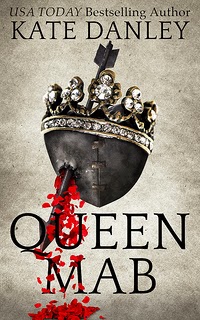
Queen Mab is the story of Romeo & Juliet told from the viewpoint of Queen Mab. There have been a lot of fantasy authors recently who have been getting Mab (the fairy queen of dreams) confused with Maeve (the queen of the dark fairy court), so I decided to bring Mab back to her roots.  She was created by Shakespeare (much like Coke defined Santa Claus) and appears in only one speech in the entire play.  I posed the question: What if she was real and her love for Mercutio was, in fact, responsible for everything that happened to Shakespeare’s star-crossed lovers?  What came out was a dark, romantic fairy tale that I still can’t believe I actually wrote.
How did signing with 47North come about?
I had submitted my book The Woodcutter to publishers for about five years and no one would touch it. It KILLED me. I knew I had this beautiful story, but it was dying a slow death on my hard drive. Then one day, I got this email saying, “If you want to be a published author and have a manuscript, just click this button and you’ll be published.”  So I did. And it was the single most important decision I ever made in my life. The Woodcutter went on to win awards, including the Garcia Award for Best Fiction Book of the Year. It caught the attention of the team at 47North, and one day I opened my email and there was a message asking me if I might be interested in talking with them. I said, “Yes.”
You’re both an actor and a writer – which is the crazier business to be in? Do you find there is much overlap in the survival skills needed for one vs. the other?

It’s funny that up until recently, being an actor was a much sounder business decision than becoming an author. Bless this glorious digital age! I never thought I’d ever be published, much less be supporting myself full-time or sitting on the USA TODAY Bestseller list. It seemed much more doable to get a national commercial than have a national bestseller. How wonderful to be wrong!
The odds are not good for either career. As an actor, the reality of the business is that you have to wait for someone to write the perfect part for you, then have someone come up with some money, then get a director who likes your type, then have an audition notice posted where you’ll find it, all for an audition against twenty other people who look just like you, and then maaaaybe you’ll get the part. But if you can write and produce for yourself… well…  It makes things just a wee bit easier. Being a self-publisher mirrors that experience. I can either wait for an agent and publisher to have room on their docket for someone like me and hope that I get past the slush pile… or just do it myself.
But what acting taught me was work ethic. It doesn’t matter what’s going on in your life, the curtain will go up and you will go on, and an audience doesn’t care if you’re having a bad day or sick or just not “feeling” it.  If you’re not committed 100%, you look like the jerk. Showing up at the computer each day is a piece of cake compared to a cattle call. Promoting your book beats the pants off of mailing headshots and resumes. Getting a cover designer is very much like getting headshots done. The business of writing and acting are the same beast. You’re marketing your brain, but one is wrapped up in the package of your face, and the other is wrapped up in the package of your words.  
You’ve also given self-publishing a try and done well. Comparing the two experiences, do you have any advice for those of us who might want to try the hybrid approach and dip our toes in self-publishing waters in the future?

Do it!  Listen, this is just my experience, and if you’re given a hammer everything looks like a nail, but man… self-publishing changed my life.  It was the single best decision I ever made.  Your manuscript is doing you no good sitting in a drawer gathering dust.  The self-publishing lists are the new slush piles.  In a best case scenario, if your manuscript was picked up by the first agent who read it, shopped around and picked up by the first publisher they pitched it to and goes through the entire publishing process, you’re looking at least a year and a half before your book gets on a shelf.  Or you can be earning money (70% royalties) that entire time.
So, what I recommend is lurking around kboards.com in the Writers Café.  It is where all the cool indie authors are hanging out.  We share marketing information, advice, encouragement, etc. all for free.  You’ll find information on cover designers, editors, aggregators, you name it, again, all for free.  And when you’re ready, I thoroughly recommend Draft2Digital.com (for publishing your ebooks) and CreateSpace (for publishing your paperbacks.  They print a book when someone buys it, so you don’t have to buy 1000 copies and try to sell them out of the trunk of your car).  Both are free to use.  You just upload your manuscript and they take care of the rest.  They list it on all the sites, they send out your stuff to anyone who buys it, they collect the money, and deposit it in your bank account.  They take a small percentage (I think 6% of each ebook sale and around $5 for each book), but no other money is exchanged.
Do you outline your books in advance or are you the fly-by-the-seat-of-your-pants kind of writer?
I’m both.  I feel that my books are better when I “pants” it, but I’ve had the privilege of getting some contracts this past year.  In those situations, there are people who want to know where you’re going with your story and they want your book churned out in a certain amount of time.  So for those, I outline.
Where do you get your best writing done? Home, coffeehouse, other?
I love writing at home, but I’m a coffeehouse junkie.  The gently hum of humanity and the white noise of garage rock in the background gets my Muse boogie-ing.
Do you have a daily word count that you aim for?
I write for fifteen minutes every day no matter what (and I set a timer).  I find my biggest hurdle each day is just getting started.  So, if I tell myself “just fifteen minutes”, I can usually write for hours.  There are times I do need to set daily word counts, though, and that is usually determined by deadlines divisible by how many days I have left.
Just because I’m curious about how other authors function — do you read your Amazon and Goodreads reviews?
I used to read everything, but I have a tender little soul and now only read my good reviews.  Haters gonna hate.  *insert mental picture of me strolling down the street with a big dumb grin on my face*
Favorite social media site and why?
I love Tumblr.  I started off blogging during the golden age, and when that era died, all of my online friends migrated to Tumblr.  I have online friendships there that have lasted over a decade.
E-books or paper ones?
Can I pick “C- All of the Above”?  For me, heaven smells like the pages of a leather-bound book and I will always love paper.  But I adore my Kindle.  I travel internationally and there is nothing like being able to tuck an entire library into my bag as I catch a train.
Finally, what are you working on now?
I have a fun little urban fantasy series called Maggie MacKay: Magical Tracker.  The first book is in a boxed set called Magic After Dark which has been on the USA TODAYbestseller list for the past four weeks.  It has also been optioned for a television series.  So, I’m working on Book IV: M&K Tracking and hope to have that out in the next few months.  I’m also working on Book III in the O’Hare House Mystery series.  A detractor described it as a demonic Clue.  I was like, “And the problem is…?” Between those two series, I should be kept busy for the next year.
But as far as what’s coming out next, I have a short in an exciting anthology coming out in January that I am very proud of (can’t say much about it, but it is really, really cool).  And I also worked with Lee Goldberg (co-writer of Janet Evanovich’s latest book), William Rabkin (Psych), Lisa Klink (Star Trek), and Phoef Sutton (Cheers) on the new Dead Man: Reborn serial, also coming out in January.
******* 
USA Today bestselling author Kate Danley began her career with the novel The Woodcutter(published by 47North). It was honored with the Garcia Award for the Best Fiction Book of the Year, the 1st Place Fantasy Book in the Reader Views Literary Awards, and was the 1st place winner of the Sci-Fi/Fantasy category in the Next Generation Indie Book Awards. Her other titles include Queen Mab, the Maggie MacKay: Magical Tracker series, and the O’Hare House Mysteries.

Her plays have been produced in New York, Los Angeles, and DC Metro area. Her screenplay Fairy Blood won 1st Place in the Breckenridge Festival of Film Screenwriting Competition in the Action/Adventure Category. Her projects The Playhouse, Dog Days, Sock Zombie, SuperPout, and Sports Scents can be seen in festivals and on the internet. She has over 300+ film, television, and theatre credits to her name, and specializes in sketch, improv, stand-up, and Shakespeare. She trained in on-camera puppetry with Mr. Snuffleupagus and played the head of a 20-foot dinosaur on an NBC pilot.

She lost on Hollywood Squares.
Find out more about Kate Danley and her books:
Categories
Uncategorized

Author Fair this Saturday

Just a quick reminder that I will be at the at the Galaxie Library in Apple Valley this Saturday (November 16), from 1-4 pm. It’s an author fair, so if you have some free time on what promises to be a gray autumn weekend, drop by to say hello or get a book signed or enter the book raffle. There will be a guest speaker, Lorna Landvik, and four free Loft workshops to choose from: Writing Children’s Books, Novel Writing, Writing & Illustrating Children’s Books, and So You Want to Find an Agent. More information can be found hereHope to see you there!

Categories
Uncategorized

Guest Post by Jeff Wheeler: Here There Be Dragons

The great 47North blog swap of 2013 continues! I’m on Jeff Wheeler’s blog today (talking about History’s Mysteries, or where to look for the story) and he is here to tell us how maps help shape his books. Read on:

There is something essential about having a map in a fantasy world. Back during medieval times, a cartographer would reach the edge of their known world and often draw a picture of a dragon or a sea serpent with the label, “Here There Be Dragons”—meaning, in short, “I have no idea what’s over here.”

I write fantasy fiction and maps have always intrigued me and are a key part of my writing process. Just as the story evolves, so do the maps as I continue to build the world and explore new areas. Let me illustrate how this works using the world of Landmoor as an example.


First off, I am not an artist. Sometimes I sketch my maps on my computer and sometimes I sketch it by hand. There needs to be a mix of mountains, forests, valleys, and rivers. There are little stories behind each of the countries and places and how their history fits into the general plot. I like to keep the borders of my worlds rather vague, suggesting that there are places that have not been discovered yet; where the dragons live, so to speak. It gives me flexibility as an author to continue building the world.

When I was writing my novels Landmoor and Silverkin, I was lucky to have a digital artist friend, Reuben Fox, who took my pathetic rendering and transformed it into the lush map you see above. But the maps always start out as black and white in my head or on the page.

Another question I get asked is how I choose all the place names. This is part of the creative process that I really enjoy and I rarely have trouble coming up with new names. I have a notebook where I write down different character and place names when the flashes of inspiration strike and I often consult that list to pick and choose. I also study maps of this world to be inspired by countries, cities, rivers, and mountains that exist today. But in each of my worlds, there are usually a few key locations which are part of the storyline, the pivot around which the plot rotates.

Take Landmoor—for example. When I was first creating that world, the plot centered around a small fortified town near the edge of a swamp and close to the sea—kind of like a medieval New Orleans. That was the first location I crafted in the world. A moor is a swamp. I stuck the name “land” to it and liked how it looked on paper (I was fourteen when I first imagined that story). I’m always combining words and testing out how they fit together. As the plot of the world began to develop, I realized that there were three different political powers struggling for control over the valley between the two mountain ranges. Because the valley has limited ground, it caused military and political tensions between them. Landmoor became a crossroads for this conflict and provided a place where the tensions intersected and flared up. Add a secret magic hidden in the swamps, some powerful sorcerers manipulating the kingdoms, and soon you have a situation ripe with tension and conflict in which to plop the main character, the son of an eminent trading family who longs to escape his social class and explore the kingdoms outside his stifling cultural expectations.

Now, even though maps are so important to me, I’ve often been asked why I didn’t include one in the world of the Muirwood Trilogy. I do have maps of this world and use them for reference, but I did not include any with the novels deliberately. You see, in Landmoor the main character, Thealos, comes from a trading family and he knows the world he grew up in. He’s familiar with the borders and the politics. In Muirwood, the main character is a kitchen servant who only knows the grounds of Muirwood Abbey where she was abandoned as a baby. As she leaves that world, she is completely lost in a vast world full of locations and politics she knows nothing about. Readers explore the world through Lia’s eyes and there is no looking ahead, trying to use the map to predict the plot or where she may end up. In the first book, she explores the land around her beloved Abbey. In the second book, she gets to see more the kingdom she lives in. In the third book, she leaves her kingdom and travels to another. I left the reader blind on purpose.

One of the neatest things about creating a new fantasy world is that I don’t determine everything in advance. I use a general map as a framework for where the action will happen. But often as the characters wander around a bit, I weave in elements from my own personal travels or places I wish to travel someday.

Let me go back to Muirwood for a moment. I knew the main character, Lia, was a scullion abandoned at an Abbey kitchen. I began searching Google for medieval kitchens to help inspire me. I found a striking image of the Abbot’s kitchen at Glastonbury Abbey in England. I even went so far as to e-mail the groundskeeper and ask for pictures from the inside, which he generously e-mailed to me. On the Abbey’s website, I found an image of the grounds:

On that map, I discovered delightful details, like the Cider Orchard which played a prominent role in the story. This was the beginning of the world. Then I hunted down an ancient map of Glastonbury and the environment around and that research led to other opportunities for topography, climate, and story ideas. Before I had crafted the first chapters, exploring this map inspired many of the scenes that would later happen.

World-building doesn’t happen all at once. While mine begins with a map and a general understanding of the plot and characters and how they will mesh together, I explore the world with my characters leading the way and invent the things that need to be filled in.

Currently, I’m writing the last book of the Mirrowen Trilogy. Yes, it also started with a hand-sketched map. On the northern edge of the map is a scribbled area known as The Scourgelands. For the first two books of the series, I’ve hinted at how dangerous and perilous it is. Now I’ve dragged my characters into the midst of it and am trying to make the journey fit the hype. It’s a land of nightmares and forgotten magic. I can’t wait to drag my readers there next. Perhaps I should post a sign outside that reads, “Here There Be Dragons.”


****

Jeff Wheeler (@muirwoodwheeler) is a writer from 7-10PM on Wednesday nights. The rest of the time, he works for Intel Corporation, is a husband and the father of five kids, and a leader in his local church. He lives in Rocklin, California. When he isn’t listening to books during his commute, he is dreaming up new stories to write.
More information about how he became a writer is found on his website:
http://www.jeff-wheeler.com/
Facebook page:
http://www.facebook.com/muirwoodwheeler
You can find out more about Jeff’s books on his Amazon page

Categories
Uncategorized

A Conversation with Anne Charnock

Today I chat with Anne Charnock, author of A Calculated Life, a Dystopian vision of corporate life in 21st century, which releases this week. We conversed about her switch from journalism to fiction and the ups and downs of the writing life.
Without further ado:

Neve:  Anne, congrats on your debut novel — I’m looking forward to reading it! What prompted the switch from science journalism to science fiction? Was fiction writing something you had always wanted to try, or did you wake up one morning with the idea for A Calculated Life and it took off from there?
Anne:Thanks! … In my journalism days I didn’t think I could make the leap to fiction. I thought the discipline of writing news and features – to an exact number of column inches – would make my writing too tight for fiction. But I took a break from journalism and studied fine art for several years during which time I was asking the question, What is it to be human? My studio tutor nudged me into writing a short story. I realized – my thunderbolt moment – that I should try to answer my question by writing a novel. That’s when I started writing A Calculated Life.
I studied environmental sciences when I left school – a good generalist starting point for journalism. But you are a proper scientist, Neve. Tell me more about that and how that specialist knowledge fed into your writing.
Neve: I started my career as a research engineer before switching to fiction writing. Both are creative endeavors, but in science fiction you don’t have to stick to the rules of this universe. You can be as inventive as you like! 
I had to learn to ignore that inner voice which I developed in my graduate studies, the one that kept bringing up issues like Shouldn’t Felix (the main character in Regarding Ducks) need to use the bathroom? Isn’t he hungry? How does he know anything for sure? Science is built on a rock-solid foundation, brick by brick, but fiction isn’t like that. You get to do more hand-waving. 
Nowadays, the copyediting stage of things, when you’re proofreading and double-checking what you’ve written, is the part of publishing a book that I probably enjoy the least. I think I revert to my engineer self and worry I’ll discover a big flaw or something.
Anne:I agree with you on the copyediting. It’s the final checks on punctuation that I find frustrating. You know those little issues like: should this question mark be in italics? Punctuation and grammar are pretty standard for business reports, formal letters and so on. It’s not so fixed when you’re writing fiction – interior monologue, for example – but you still have to be consistent.
The part I enjoy the most is when I’m in the midst of writing a story, when I’m not sure where it’s going, when I’m happy to go with the flow. And I particularly like writing dialogue. I think that’s partly because I lived in a noisy household as a child – four brothers, a sister, and five cousins living next door. There were so much bantering going on, lots of interrupted speech!
How about you Neve? With your third novel nearing completion, you must know what kind of writing comes easiest to you.
Neve: It’s dialogue writing for me as well. That’s the part that flows the easiest, where you get to know your characters. In terms of the writing process as a whole, from blank page to publication, the part I enjoy the most is when you have that first draft done and it’s starting to look like a book… and now you get to sit down with a red pen in hand and make it a stronger book. It’s when the story finally comes together. Do you find that as well, Anne, that it’s not until the very end that you figure out what the story has been about? Or are you a more organized writer than I am and work from a detailed outline? It seems like that would be faster.
Anne: Yes, I have to admit that during the first draft there are difficult times when I feel like I’m pulling my own teeth out. I like the process of refinement, which takes place as you know, Neve, on many levels – improving each sentence, adding scenes, scrapping a character. Brutal stuff. Moving a scene is more problematic because it has a ripple effect through the manuscript. I changed my opening scene twice. I didn’t delete those earlier opening scenes – I moved them.
I certainly don’t outline. But once I have the first draft, I try to be strategic in working out how to clarify my themes by the addition of new sections or by modifying passages of dialogue. That’s good fun and, of course, at that stage I’m not thinking about marketing the book.
In the UK, it has been difficult for women science fiction writers to get publishing contracts in recent years. So it was a huge relief when a US publisher, 47North, approached me. What’s the situation in the US? Do women SF writers feel they’re increasingly out of the loop?
Neve: I hadn’t heard that about UK publishers, that’s maddening. Personally, I never got to be rejected by publishers — I couldn’t get past the agent gatekeepers! The feedback I got from agents about Regarding Ducks (when I got feedback) was that they thought it was well-written and interesting… and too experimental to pitch to publishers. So I, too, was glad when Amazon Publishing found me (through the Amazon Breakthrough Novel Award contest). Did you send your manuscript to agents or publishers at all, Anne, or did you go straight to self-publishing? How did you make that decision?
As to whether women SF writers in the US feel left out of the loop, I suppose I’m out of the loop by definition: I spend most of my time at my desk, have been to only two conferences (neither SF), and am not a member of Science Fiction Writers’ Association. You hear and read things, of course. I think it’s great that nowadays we have more paths open to us as writers than we used to.   
Anne: With my novel released this week, I’m planning to stay at my desk, too. I’ll follow your example. It’s time to pick up the pace with my story writing! However, I will go to some conferences next year – I always go to the Hay Literature Festival on the English/Welsh border and I’ll blog about various author events as I did this year. But before Hay, I’ll be going to Norwescon in Seattle, which I’m already excited about.
I did try the traditional publishing route, Neve, without success. I received positive feedback from several agents (and one publisher that I approached direct) but no one signed me up. I knew that publishing houses were starting to pick up self-published titles and that made sense – the market had already tested those titles! So I took the plunge. It involved a humungous amount of work, and as an indie-author I had to find ways to become visible! So I used my journalism experience to start a blog and that’s been a fab spin-off because I love posting. And I also blog for The Huffington Post. From now, I have to get the balance right between blogging and writing fiction.
So, agents found your work too experimental. Would you like to expand on that? And tell me more about the sequel you’re writing.
Neve:  I am glad you found a route that worked for you, Anne! Are you working on a new book these days?
As for my own stuff, I didn’t feel it was too experimental (for all I know, maybe that was just a polite way for agents to turn down representation). In any case, I have to say I’m glad to be past that stage and can now focus just on the writing. Well, other than obsessing about reviews, sales numbers, my Amazon rank, and so on… The sequel to The Far Time Incident has just gone through its copyedit — only 5 months to go before publication!  
Anne: I’m writing short stories at the moment because I want to try out a few ideas without committing to a full novel. But I expect I’ll start the next  novel soon. I can feel the itch to get started on a big project. Any advice for a debut novelist about to start on the second novel?
Neve: I’d say what I’ve found tricky is time management, especially with a series. You’re doing publicity and marketing for the first book while writing the next one and coming up with ideas for the one after that. It’s a lot of balls to have up in the air.
Good luck with the book launch this week, Anne, and good to talk to you!
Anne: Thanks! Let’s hope we can meet up sometime – maybe at Norwescon. We do have to come out our caves occasionally!

Anne’s writing career began in journalism. Her articles appeared in The GuardianNew ScientistInternational Herald Tribune, and Geographical. She travelled widely as a foreign correspondent and spent a year trekking through Egypt, Sudan, and Kenya. Anne is an active blogger and contributes reviews and book recommendations to the Huffington Post. She splits her time between London and Chester and, whenever possible, she and her husband, Garry, take off in their little campervan to southern Europe, and as far as the Anti-Atlas Mountains in southern Morocco. To find out more about Anne and her books, follow these links: